In today’s high-cost housing market, more buyers are turning to fixer-uppers as a way to break into homeownership or invest in long-term value. Typical profit margin on home flips across the U.S. rose to 29.6% in 2024. For everyday buyers, a fixer-upper can offer a similar promise: a lower purchase price and the potential to create something tailored, personal, and—ideally—profitable. As a company specializing in home remodeling, Mad City Windows and Baths understands the appeal and the challenges of turning a fixer-upper into a functional, stylish living space.
To understand where these opportunities are most compelling, we analyzed fixer-upper home listings in 50 of the largest U.S. cities. We compared the median price of homes classified as “fixer-upper” to the overall median home price in each city. We also calculated how affordable these homes are relative to local incomes and how quickly they’re selling in each market.
From cities where fixer-uppers come at a 60% discount to those where renovation-ready homes are sold in under two weeks, this study reveals where buyers may find the best mix of value, speed, and opportunity, whether they’re first-time homeowners or seasoned renovators.
U.S. Cities with the Deepest Fixer-Upper Home Discounts
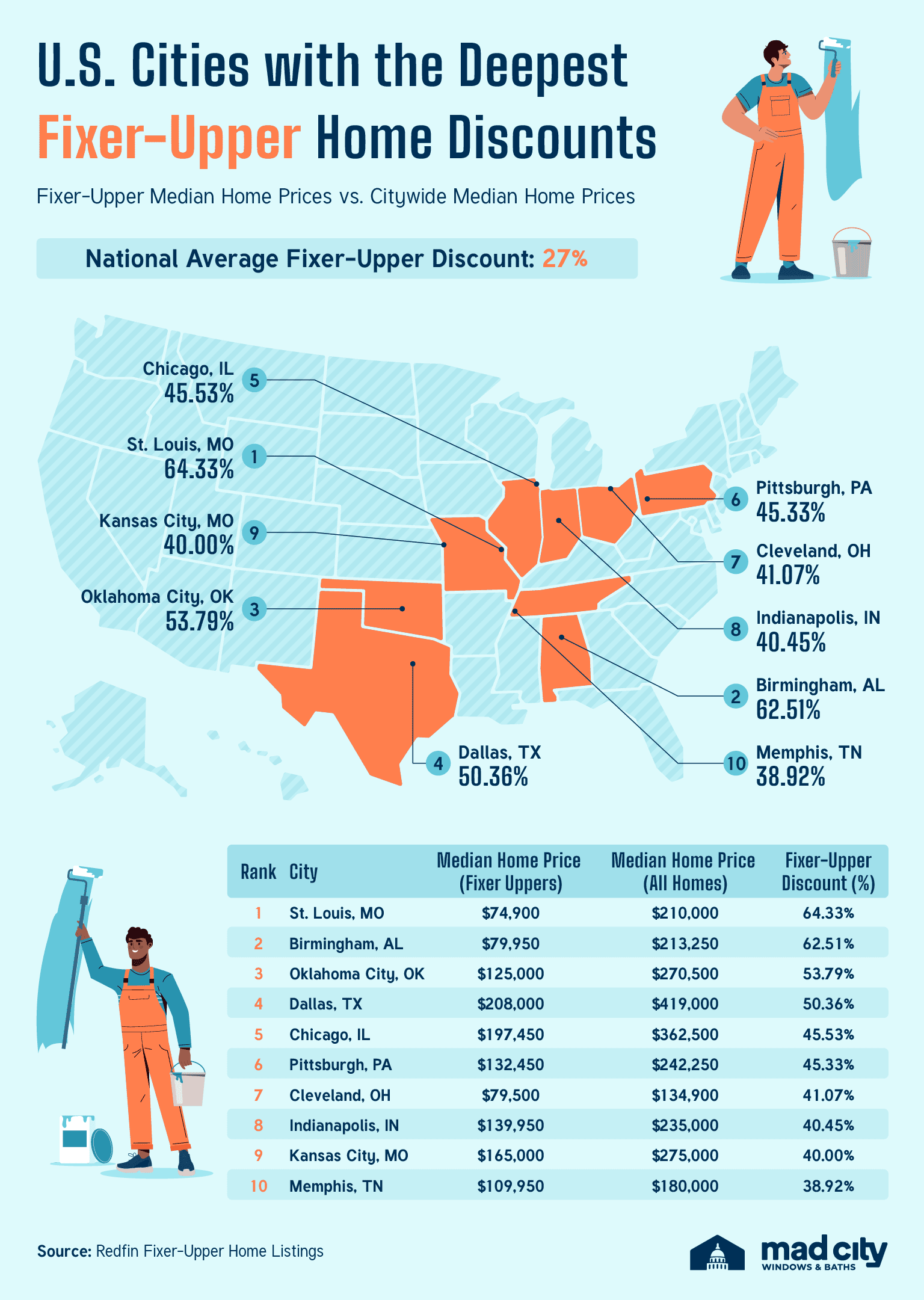
In more than half of the 50 cities analyzed in the study, purchasing a fixer-upper can shave over 30% off the typical home price, a compelling figure for savvy buyers with vision and patience. We analyzed where the price gap between fixer-uppers and average home prices is the widest.
Here are the five U.S. cities where fixer-uppers cost the least compared to citywide averages:
- St. Louis, MO: 64.33% discount on fixer-upper homes
- Birmingham, AL: 62.51% discount
- Oklahoma City, OK: 53.79% discount
- Dallas, TX: 50.36% discount
- Chicago, IL: 45.53% discount
At the top of the list is St. Louis, MO, where the price gap between fixer-uppers and the citywide median is nothing short of dramatic. With median prices for fixer-uppers at just $74,900—compared to $210,000 citywide—buyers are seeing a remarkable 64.3% discount.
Other cities, particularly in the South and Midwest, also present significant opportunities. In Birmingham, AL, fixer-uppers list for a median of $79,950, while the citywide median is more than double that at $213,250, a 62.5% savings. Oklahoma City, OK, follows closely, where buyers can expect to pay around $125,000 for a fixer-upper versus $270,500 for the average home, translating to a 54% discount.
Major metros aren’t exempt from this trend. In Dallas, TX, fixer-upper homes are priced at a median of $208,000, more than 50% below the city’s median home price of $419,000. And in Chicago, IL, the median price for a fixer-upper sits at $197,450, compared to $362,500 citywide, offering a 45.5% discount.
Some honorable mentions deserve attention as well. In Pittsburgh, PA (#6), fixer-uppers come at a 45.3% discount compared to citywide averages. Cleveland, OH (#7), Indianapolis, IN (#8), and Kansas City, MO (#9) all offer price breaks of 40% or more, a noteworthy advantage for buyers with an appetite for renovation. Rounding out the top 10 is Memphis, TN, where the median price for a fixer-upper is $109,950, compared to a citywide median of $180,000, offering a discount just shy of 39%.
For context, cities like New York City (7.3%), Los Angeles (7.5%), and Denver, CO (8.9%) offer far smaller relative savings on fixer-upper homes.
Whether you’re a first-time buyer seeking a more affordable entry point or an investor with an eye for potential, these markets offer real value—provided you’re ready to roll up your sleeves.
U.S. Cities Where Fixer-Upper Homes Are Most Affordable

Affordability isn’t just about price. It’s also about how far your income goes. In more than half of the 50 U.S. cities analyzed, the median household income is more than enough to comfortably afford a fixer-upper home. These markets stand out not only for offering steep discounts but also for making renovation-friendly properties financially attainable for the average buyer.
Here are the five U.S. cities where fixer-upper homes are the most affordable relative to local income:
- St. Louis, MO: 62.08% surplus
- Detroit, MI: 55.53% surplus
- Oklahoma City, OK: 50.23% surplus
- Birmingham, AL: 50.06% surplus
- Pittsburgh, PA: 45.43% surplus
At the top of the list, once again, is St. Louis, where the median household income is $55,279, while the income needed to afford a fixer-upper home is just $20,960. That’s a 62% surplus, making it one of the most attainable markets for buyers interested in renovation opportunities.
In Detroit, MI, fixer-uppers require just $17,600 in income, compared to a citywide median of $39,575. Oklahoma City shows a similar trend, with a required income of $33,200 and a citywide median of $66,702. Both cities offer income surpluses of 50% or more.
Birmingham also ranks highly for affordability, with a $22,160 income threshold for fixer-uppers and a median household income of $44,376. In Pittsburgh, the income needed to afford a fixer-upper is $35,000, well below the city’s $64,137 median, leaving a 45% buffer for buyers.
Cleveland, Memphis, Indianapolis, Kansas City, and Chicago round out the top 10, with income surpluses ranging from 32 to 44%. Even in a major metro like Chicago, fixer-uppers require significantly less income to afford, at $50,920 compared to the city’s median household income of $75,134.
Other cities worth highlighting include Milwaukee, WI, Buffalo, NY, and Columbus, OH. In Milwaukee, the median household income is $51,888, while fixer-upper buyers need only $36,160. In Buffalo, the gap is similar, with a $48,050 median income and $34,400 needed for a fixer-upper. And in Columbus, the typical household earns $65,327, comfortably above the $46,960 required.
For those with the time, skills, or resources to renovate, these markets offer a clear path to more affordable homeownership.
U.S. Cities Where Fixer-Upper Homes Are Selling the Fastest
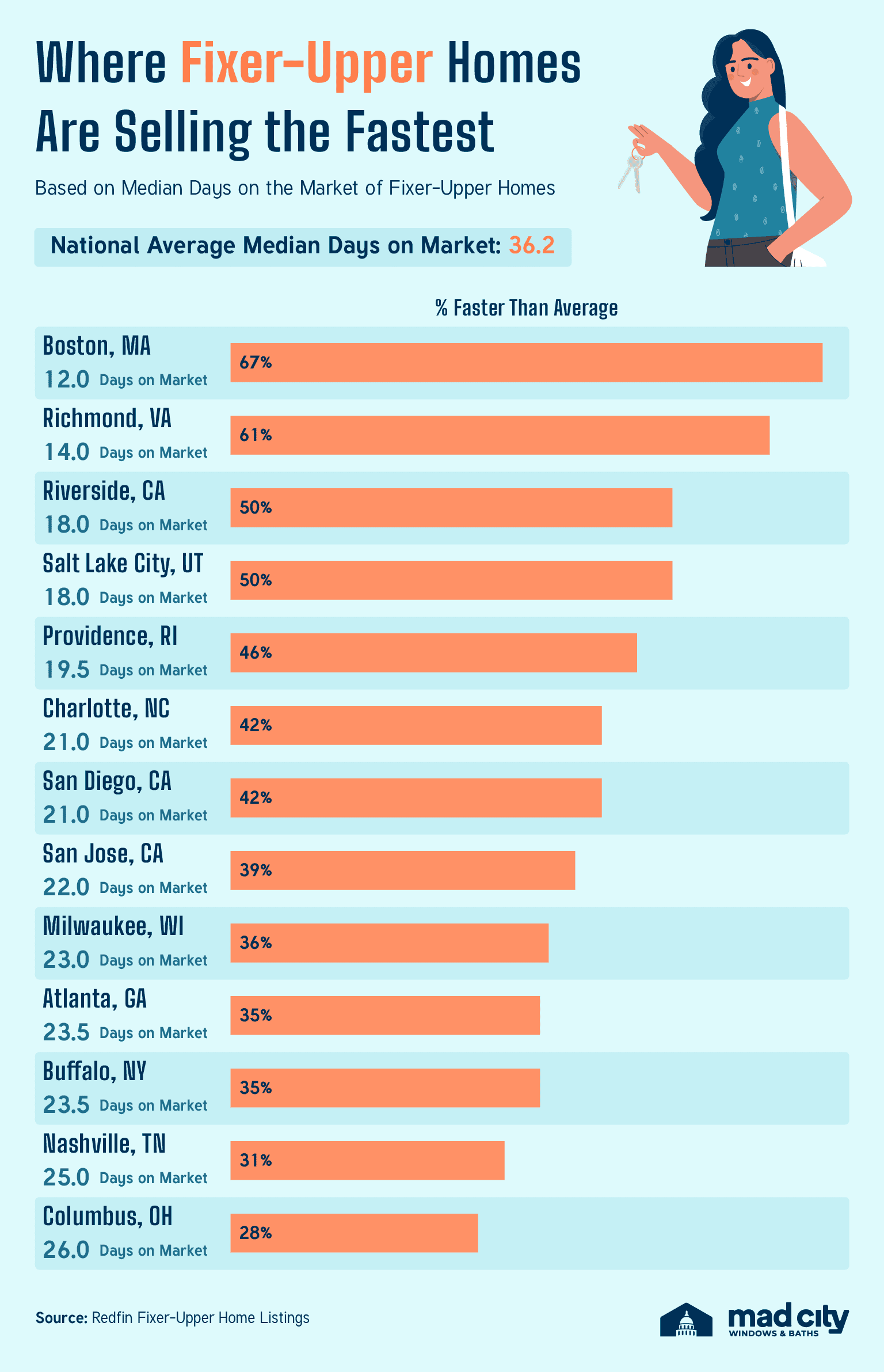
Fixer-upper homes may need some elbow grease, but in many U.S. cities, they’re flying off the market well ahead of the national pace. Across the country, the average fixer-upper stays on the market for about 36 days. But in some cities, that window is nearly cut in half (or more), suggesting high demand from buyers eager to renovate, customize, or invest.
In Boston, MA, fixer-uppers sell in just 12 days, a full 67% faster than the national average. Richmond, VA, sees similarly brisk sales, with these homes lasting just 14 days on the market. In Riverside, CA, and Salt Lake City, UT, fixer-uppers are listed for only 18 days, which is 50% faster than average.
Providence, RI, isn’t far behind, where fixer-uppers spend just under 20 days on the market. Charlotte, NC, and San Diego, CA, both see median listing times of 21 days, while in San Jose, CA, it’s 22. In Milwaukee, fixer-uppers are typically listed for 23 days—about 36% faster than the national average.
Other metros rounding out the top 10 include Atlanta, GA, and Buffalo, where fixer-uppers last around 23.5 days, and Nashville, TN, where they sell in 25. Columbus closes out the group with a 26-day median, still 28% faster than the national benchmark.
Fast-moving fixer-uppers are often a sign of limited inventory, strong investor interest, or a highly competitive housing market where buyers are eager to get in, even if the property needs work. In these cities, homes that need a little love aren’t staying on the market for long.
Full Data
Curious how the cost of a fixer-upper home in your city compares? Explore the full dataset below to see detailed figures for all 50 U.S. cities we analyzed. Use the search bar to find your state or click on any column heading to sort the table by category.
Closing Thoughts
From steep discounts to surprising affordability, this study highlights the real potential of fixer-upper homes in cities across the U.S. Whether you’re looking to save money on the front end, renovate on a budget, or invest in a fast-moving market, buying a home that needs a little work can offer both financial and creative rewards.
Fixer-uppers often come with big plans, such as:
And that’s where Mad City steps in. With service areas in many of the top-ranking cities from our study, including Indianapolis, Milwaukee, Pittsburgh, and St. Louis, Mad City helps homeowners transform “good bones” into dream homes.
If you’re considering buying a fixer-upper or already have one in need of a refresh, get started here to learn how we can help bring your vision to life.
Methodology
We analyzed Redfin home listings across 50 of the largest U.S. cities, focusing specifically on properties labeled as “fixer-uppers” to determine the median price of renovation-ready homes in each market. To provide context, we also used Redfin’s housing market data to identify the median home price for all residential listings in each city. By comparing these two figures, we calculated the percentage discount associated with buying a fixer-upper, ultimately showing where buyers can save the most by opting for a home that needs a little TLC.
Next, we used the median price of a fixer-upper home in each city, along with a standard 20% down payment and current mortgage rates from the Federal Reserve Bank of St. Louis (FRED), to estimate the typical monthly mortgage payment for fixer-upper homes. Applying the widely recommended home-buying guideline—spending no more than 30% of income on housing—we then calculated the annual income needed to comfortably afford a fixer-upper in each market. Finally, we compared these figures to each city’s median household income from the U.S. Census Bureau to highlight where fixer-uppers are most within financial reach for local buyers.
To supplement our study, we analyzed the median number of days fixer-upper homes spend on the market in each city using the Redfin listings data, revealing where these homes are selling the fastest.